
- Home
- Restoration, Conservation, and Preservation
Restoration, Conservation, and Preservation
Approaches, materials, and decision paths for maintaining, stabilizing, and restoring gilded objects and historic surfaces
Work on historic gilded objects sits on a spectrum. At one end is conservation—stabilizing and protecting original material with minimal intervention. At the other is restoration—rebuilding losses and returning an object closer to its intended appearance. Preservation supports both by controlling environment, handling, and maintenance to slow future deterioration. Understanding where your project sits on this spectrum determines every material and process decision that follows.
Choose the approach before selecting products. Some projects call for reversible conservation-grade materials and localized repair. Others require full surface reconstruction using traditional gesso, bole, and water gilding. Many fall in between—selective inpainting, patching, or re-leafing—guided by documentation, ethics, and the value of the original work.
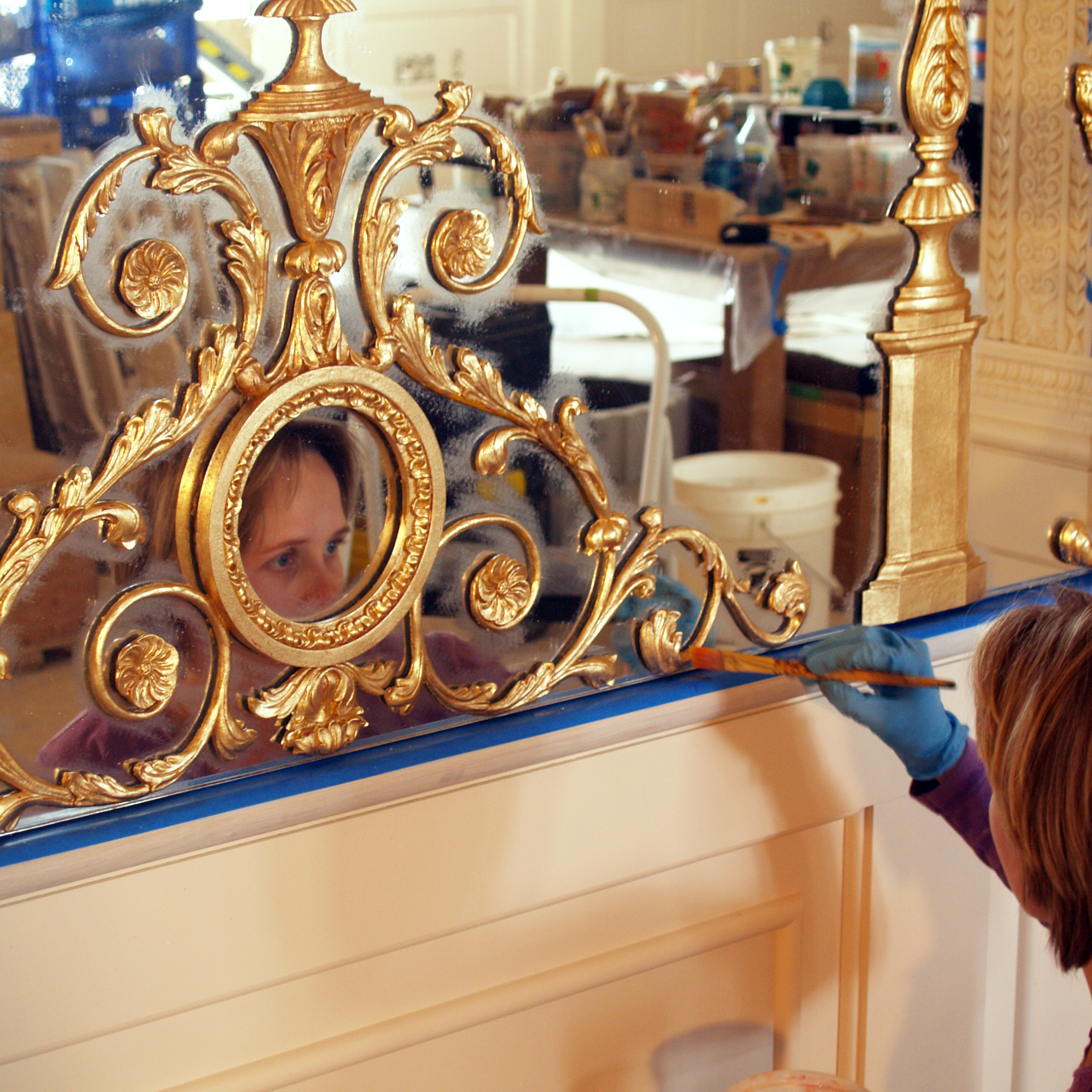
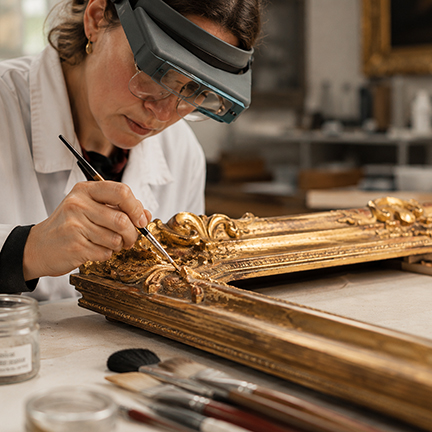
Path 1: Conservation
Best for stabilizing original material with minimal intervention. Focus on consolidation, cleaning, and reversible methods that preserve authenticity and documentation.
Typical actions include surface cleaning, consolidation of friable gesso, localized edge securing, and selective inpainting without full re-gilding.

Path 2: Restoration
Best for rebuilding losses and returning visual continuity where damage is extensive. May include re-creating ground, re-establishing bole, and re-gilding to match surrounding areas.
Often uses traditional systems—gesso, bole, water gilding—paired with careful color matching, patination, and blending.

Path 3: Preservation
Best for preventing future damage. Focus on environment, handling, mounting, and protective measures that extend the life of existing finishes.
Includes sealing where appropriate, UV considerations, humidity control, and safe transport and storage practices.
Where Restoration Work Fits
Gilded surfaces fail in predictable ways: abrasion, losses to edges and high points, cracking in grounds, delamination, tarnish on metal leaf, and overcleaning from past interventions. The appropriate response depends on significance and condition. High-value or historically important objects favor conservation. Decorative or heavily damaged objects may justify restoration. Many projects combine both approaches.
Choosing correctly protects value and integrity. Over-restoration can erase history; under-treatment can accelerate loss. The goal is a balanced approach guided by documentation, reversibility where possible, and compatibility of materials.
Reversibility
Conservation-grade work favors materials and methods that can be undone without harming the original substrate.
Compatibility
New materials must work with old ones—mechanically and visually—to avoid future failure or mismatch.
Documentation
Record condition, materials, and steps taken. Good documentation preserves knowledge and supports future treatment.
Core Material Decisions
Clean or Leave
Assess whether surface dirt or coatings should be reduced. Test first; avoid aggressive cleaning that alters original finishes.
Consolidate or Rebuild
Stabilize fragile gesso and bole where possible. Rebuild only where losses compromise structure or readability.
Match or Contrast
Decide whether repairs should blend invisibly or remain discernible upon close inspection, depending on conservation ethics and client goals.
Typical Treatments
Surface Cleaning
Dry cleaning and controlled wet cleaning to remove soot, grime, and non-original coatings while preserving original leaf.
Loss Compensation
Filling losses in gesso, re-establishing bole, and re-leafing small areas with careful edge blending and patination.
Toning & Inpainting
Using reversible paints or glazes to integrate repairs visually without over-restoring.
Suggested Starting Sequence
Step 1: Assess and document.
Photograph, map damage, and identify materials. Decide conservation vs restoration vs preservation.
Step 2: Test and stabilize.
Run small tests for cleaning and consolidation. Secure fragile areas before any further work.
Step 3: Treat selectively.
Clean, fill, re-establish ground where needed, re-leaf selectively, and tone to integrate.
High-Value or Historic?
Favor conservation: minimal intervention, reversible materials, and thorough documentation.
Extensive Loss?
Plan restoration: rebuild gesso/bole where necessary and re-gild to restore continuity.
Ongoing Care?
Implement preservation: environment control, handling protocols, and protective measures.
Professional Insight
The most important decision in restoration is not the product—it is the level of intervention. Once that is defined, the correct materials become clear. Experienced practitioners move slowly, test often, and prioritize reversibility where appropriate.
Gold is unforgiving: it reveals every decision beneath it. Respect the original surface, match systems carefully, and let the object guide the treatment rather than forcing a uniform finish.